Vocabulary is the number one task for language learners. This “Essential Business English Terms” glossary is appropriate for anyone who wants to expand their Business English vocabulary and is especially intended for non native speakers at an intermediate or higher level. This list is very far from exhaustive (= it is far from complete), but it can help you measure your vocabulary knowledge, and we hope, teach you some new key Business English terms.
If this little vocabulary lesson triggers your interest in advancing your English fluency, you might want to read more about our customized, private intensive English courses, online and in Amsterdam, Den Haag, & Amstelveen.
This compact glossary is divided into ten categories of essential business vocabulary. It starts with “entrepreneurship” and ends with “corporate ethics,” but there's a lot in between! So… are you ready? Let's dive into the wordy-world of Business English, exploring the essential terms that everyone in business needs to know.
Are you looking for Business English training? What makes us the best choice?
| 100% Native-Speaker Trainers | Business English Specialists | CEDEO-erkend Certified Courses |
|---|---|---|
| Gain authentic insights and pronunciation | Expertise in professional language skills | Recognized excellence in English education |
See what our clients say about us at Trustpilot
Entrepreneurs are, perhaps, the rock stars of the business world. They start new companies. Many of these companies will fail, but some will prosper. Ever heard of Steve Jobs?;-) Tip: In American English, pronounce entrepreneurship as on-trə-prə-nər-ship.
1. Entrepreneur - An individual who starts and runs a business, taking on financial risks in the hope of profit.
2. Stakeholder - Any person or group who has an interest in the success and operations of a business.
3. Risk tolerance - The level to which an entrepreneur or investor is willing to risk their money.
4. Startup business or startup company - a new company.
5. Angel investor - An angel investor provides initial money for startup businesses, usually in exchange for ownership equity in the company.
6. Seed money - The initial investment needed to start a new company.
This category covers a few of the common terms related to business finance and investments, which are essential for understanding the financial dynamics of a company.
1. Asset - Anything of value owned by a business, which can provide future economic benefits.
2. Liability - Financial obligations that a company owes to others, like loans and mortgages.
3. Equity - The value of an owner’s shares within a company, representing their stake.
4. Capital - Wealth in the form of money or assets, used or invested in a business by its owners.
5. P&L - Profit and loss.
6. ROI - Return on investment.
7. Balance sheet - a statement of the assets, liabilities, and capital of a business or other organisation. It is a “snapshot,” detailing the balance of income and expenditure (=spending) over a given period of time.
The field of marketing and sales is full of specialised terminology that helps professionals strategize and communicate effectively.
1. Brand - Simply stated, a name, symbol, or design that identifies and differentiates a product from others. David Ogilvy said that a brand is “the intangible sum of a product’s attributes.” In modern usage, "brand" often refers to the totality of how people think and feel about a company and its products or services.
2. Market Research - The process of gathering, analysing, and interpreting information about a market.
3. Conversion Rate - The percentage of visitors who take a desired action, crucial in sales and marketing.
4. B2B (Business-to-Business) - Transactions conducted between companies, rather than between a company and individual consumers.
5. B2C (Business-to-Consumer) - Transactions conducted between companies and consumers, rather than between 2 companies.
6. Cold calling - Calling potential clients with whom there is no previous relationship.
7. Prospects and leads - A prospect is stronger than a lead, but most prospects start as leads. A prospect is a "qualified lead" with whom the seller has had contact. The prospect is an engaged lead, though still not yet a "sale."
8. CRM - Customer relationship management: a platform such as Hubspot or SalesForce.
Understanding human resources and employment terms is key for those involved in or interested in the management of workplace environments and employees. It’s also helpful for job seekers, especially as it relates to recruitment.
1. Recruitment - The process of finding, screening, and selecting qualified people for a job at an organisation.
2. Onboarding - The process of integrating a new employee into the organisation and its culture.
3. Turnover - The rate at which employees leave a workforce and are replaced. But watch out! The word turnover can also refer to gross income or sales over a particular period. You will know the meaning by the context in which the word is used.
4. Workforce Planning - The process of analysing, forecasting, and planning workforce supply and demand.
5. Outsourcing- The practice of having certain job functions done outside a company instead of having an in-house department handle them.
6. Background check - A method for gathering information about a job candidate, including the following “proofs'': Identity proof, proof of past employment, address proof and educational qualifications proof, among others.
7. Human capital - Employees.
For international business professionals, these are a few of the terms necessary for talking about global trade dynamics.
1. Globalisation - The process of interaction and integration among people, companies, and governments worldwide.
2. Export - Goods or services produced in one country and sold to buyers in another.
3. Import - Bringing goods or services into a country from abroad for sale.
4. Trade barrier - A government-imposed restraint on the flow of international goods or services.
5. Customs - The part of the government that enforces trade regulations and collects tariffs.
6. Tariff - A tariff is a customs duty or tax levied on imports of merchandise goods. Most of the time a tariff is a percentage of value or a specific tariff (e.g. $100 per ton).
7. Free trade - A policy that allows goods and services to be traded without restrictions or tariffs.
With the rise of digital businesses, knowledge of technology-related terms is essential. Digital language is not just for the geeks anymore ;-).
1. E-commerce - The buying and selling of goods or services using the internet.
2. Big Data - Extremely large data sets that may be analysed computationally to reveal patterns and trends.
3. Cloud Computing - The practice of using a network of remote servers hosted on the Internet to store, manage, and process data.
4. Cybersecurity - Measures taken to protect a computer or computer system against unauthorised access or attack.
5. Digital marketplace - An online store where customers can purchase digital products, such as software as a service (SaaS), infrastructure as a service (IaaS), and hardware as a service (HaaS), as well as many other types of digital offerings.
6. Multi vendor marketplace - A large-scale e-commerce store where multiple vendors can promote and sell their goods and services. Companies like Amazon, and in the Netherlands, Bol.com, are e-commerce platforms.
Legal and compliance terms are central in ensuring that businesses operate within the boundaries of law and corporate governance.
1. Compliance - Adherence (=acting in accordance with) to laws, regulations, policies, and ethical standards in business operations.
2. Intellectual Property (IP) - Legal rights arising from the intellectual activity in the industrial, scientific, literary, or artistic fields.
3. Litigation - The process of taking a dispute to a court.
4. Due Diligence - An investigation or audit of a potential investment or product to confirm all facts and financial information.
5. Code of Ethics - A document that conveys organisational values, a commitment to standards, and a set of ideals. In practice, used interchangeably with Code of Conduct.
6. Corporate attorney - a lawyer (=attorney) who is specialised in the area of the law related to corporations.
7. Lawsuit - A legal action in a court of law which deals with a dispute between two people or two organisations. Lawsuits often result in financial settlements.
Effective project management and understanding operational terms are key to ensuring business projects and processes run smoothly.
1. Milestone - A significant point or event in a project, program, or portfolio.
2. Agile - A method of project management used for software development, emphasising incremental delivery.
3. Supply Chain - The entire system of producing and delivering a product or service, from the supplier of raw materials to the end consumer.
4. Inventory Management - The supervision of non-capitalized assets, or inventory, and stock items.
5. COO - Chief Operating Officer.
6. Deliverables - The product or products of what you expect to have at the end of your project. Some examples of deliverables include a new product, a sales deck, or an increase in traffic.
Effective communication and networking are essential for business success, and these terms are foundational.
1. Elevator Pitch - A brief, persuasive speech used to spark interest in what your organisation does.
2. Stakeholder Engagement - The process of involving individuals who may be affected by the decisions made by an organisation.
3. Feedback - Input about employee performance. This can be quite formal and extensive (360 degree feedback) or just a few brief, informal comments from a superior.
4. Networking - Interacting with others to exchange information and develop professional contacts.
5. Non verbal communication - This term often refers to body language and includes any communication that is not word dependent.
6. Upward communication - Upward communication refers to the flow of information from employees or lower-level colleagues to their superiors or higher-level management. “Managing up” means managing your superiors.
7. Brainstorming - An open and lively exchange & collection of ideas, suggestions and input with little judgement or evaluation.
Understanding corporate ethics and social responsibility is key for businesses aiming to operate sustainably and ethically.
1. Corporate Social Responsibility (CSR) - A business model in which companies are responsible for the societal impacts of their activities.
2. Ethical Sourcing - The process of ensuring the products being sourced are obtained in a responsible and sustainable way. (Ethics are the moral principles that guide a person or a company’s conduct.)
3. Transparency - The practice of openly sharing information related to company operations, decisions, and performance. (Transparency is related to the adjective transparent or “see through.”)
4. Sustainability - Meeting the needs of the present without compromising the ability of future generations to meet their needs. (related to the verb “sustain.”)
5. Whistleblower – A person who (safely and privately) reports misconduct or other problems in a company. The whistleblower’s role is to report the issue to the appropriate person (always someone in authority). They do not investigate or determine the appropriate actions that may follow.
6. Circular economy - The circular economy model of production and consumption can include sharing, leasing, reusing, repairing, refurbishing and recycling existing materials and products as long as possible. In this way, products are used as long as possible, and waste is reduced.
This glossary of essential business English terms provides a resource for anyone who wants to begin enhancing their business vocabulary. As the world of business continues to evolve, staying informed with key Business English terms (both old ones and new, trending ones) will be crucial in navigating the global business landscape. Everyday new words and terms come into common usage, and we all have to keep up! This post provides just an inkling (=a little bit) of the totality of general terms for Business English, not to mention the plethora (=a lot of) specialist terms that every sector makes use of.
We hope this article helped you check your current knowledge of Business English terms as well as helping you learn some new terms. And of course, if this article inspired you to work on your English vocabulary, we’re here to help.
Contact The English Center today.
Brenda de Jong-Pauley, MA, for The English Center
Word count: approx. 2000
How to disagree diplomatically and respectfully in Business English: A lesson with 25 sample phrases
Business meetings and negotiations are often “won” by the people who are the best communicators. In your native tongue, you may be a diplomacy champ, but how skillful are you in English? Diplomacy is a social and cultural construct, and if English is not your first language, you may not be skillful in navigating the subtleties of diplomatic English.
For example, can you disagree diplomatically in English? Can you disagree clearly but politely and respectfully – without creating hurt feelings, hostility, resistance or even enemies? No? No worries! We have some advice.
Business English Conversation Course
Table of contents: How to Disagree Diplomatically
First, you have to listen. People will notice if you are texting, booking a vacation or planning your next clever comment while they are speaking. Show respect for the speaker with your face, eyes, body language and of course, your ears. And if you did not hear/understand/grasp what they said, ask them to restate it. Once you know what they said, you can connect to it and disagree diplomatically and authentically.
Many Nederlanders have a very direct approach to disagreement, but you are warned to soften that in order to keep things friendly with English speakers. Dutch directness may be respected, but it is not always appreciated. As English speakers, we apply rules of diplomacy to our conversations. So be careful that you do not appear rude “in the eyes” of your English-speaking colleagues.
Of course when you speak English with people from other cultures / other countries, expectations can be different, and some cultures do require or expect a rather direct approach, but English speakers like diplomacy.
A good way to begin to disagree diplomatically is by restating the other speaker’s point of view. For example, “Tom, I hear what you’re saying about the profits from last quarter. You’re right that they weren’t very good. However, I want to point out that there were some extraordinary conditions that caused that slump, and we don’t expect this downturn to continue.
With this restatement of Tom’s concerns, I have let him know that I heard him. But I have still clearly disagreed with his point of view.
Your colleague says, ”Mary has been doing an excellent job. I think we should give her a promotion.” If you do not agree that Mary has been doing a great job and should receive a promotion, you might say something like, “It sounds like you’re very happy with Mary’s performance and she has indeed done some great work on our team. But I have some concerns about her organizational ability, and I don’t feel that she’s ready for a promotion just yet.”
Sometimes it’s not necessary to restate what your colleague has said. Sometimes it’s as simple as saying, “I hear what you’re saying. I know you’re concerned about this problem and I am, too. However, I don’t fully agree with the solution that you’re proposing."
As you can see in the texts above and below, the conjunctions "however" and "but" are doing a lot of "heavy lifting" (=working hard) in diplomatic English. These connecting words are super important as they prepare the listener for the disagreement which follows the initial phrase.
Business English Conversation Course
The English Center offers quality intensive business English courses and Incompany Business English Courses, all fully customized to deliver the most value for you or your team. Our motto is “Business English training the way YOU want it.”
Learn about our CEDEO certification here
Download our CEDEO client satisfaction report pdf here

Since 2009, thousands of learners have trusted our courses
What do our clients think about us? Just click the TrustPilot icon to read some reviews.
Author: Brenda de Jong-Pauley, MA, Director, The English Center of Amsterdam, January 2024. Updated February 2025.
A Christmas Carol, by Charles Dickens (1812–1870), is perhaps the most beloved of all English language Christmas tales, and always feels right at this time of year. The reader need not be a Christian, or a member of any religion whatsoever, to understand the simple message of the story: Be kind. Be generous. Be a good person.
In A Christmas Carol, first published in 1843, Charles Dickens’ central character, the grouchy (=irritable, angry, bad-tempered) and miserly (= selfish, greedy, hoarding) old businessman, Ebenezer Scrooge, discovers that true success is found not in wealth, but in kindness to others.
As the story opens, Ebenezer Scrooge is a rich but mean-spirited (=unkind, selfish) old man who openly mocks (=is aggressively critical of, makes fun of) the notion (=idea or concept) of Christmas as a time for generosity (giving and sharing) and kindness. Dickens says, "Oh! but he was a tight-fisted hand (=reluctant to spend any money) at the grindstone, Scrooge! A squeezing, wrenching, grasping, scraping, clutching, covetous old sinner!" (=These adjectives all refer to greed and the desire to acquire wealth, no matter who gets hurts.)
But one cold night, when he is visited in his bedchamber (=bedroom) by 3 time-traveling ghosts, Scrooge is forced to confront (=to deal directly & honestly with) his past, present, and future.
As he faces the truth of his own greed and cruelty, under the guidance (=counsel) of the 3 powerful ghosts, Scrooge develops compassion (feelings of kindness) for what we would today call his “wounded inner child,” and by extension, for others.
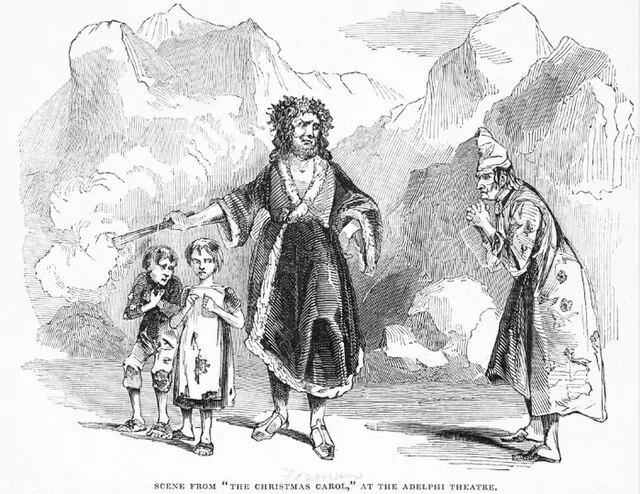
After the ghostly visits, Scrooge awakens full of good will and joy. He has truly been reborn, and understands that “charity, mercy . . . and benevolence” are everyone’s business, (= everyone's responsibility).
Charity =giving to those in need; Mercy =forgiveness/kindness; benevolence =consistently having good, kind intentions.
Truly "a new man," Scrooge runs into the snowy street and pays the first boy he sees to purchase and deliver a huge Christmas turkey to the family of his employee, Bob Cratchit. Bob has long suffered under the terrible work conditions and miserly pay at Scrooge's office and does not expect anything but cruelty from Ebenezer.
Scrooge also merrily accosts (= abruptly says hello to) some men he knows, and shocks them by offering to contribute (= to give money) to their charity. Finally, he attends his nephew's Christmas party. He is so full of sincere kindness and happiness that he is almost unrecognizable. (= it is hard to believe he is the same person).
The next day, when Scrooge and Bob Cratchit are back at work, Scrooge pretends to be his old, mean self, but then surprises Cratchit with a huge raise (=a much larger salary) and help for Bob's troubled family.
Scrooge continues to be a good man. He becomes a "second father" to TIny Tim, the sickly son of Bob Cratchit, who, according to the Ghost of Christmas Future, was going to die. But because of Ebenezer's newly found kindness, the boy is saved, and Scrooge carries the kind and generous Christmas spirit forward into every single day of his life.
The narrator concludes the story by quoting Tiny Tim, who says, "God bless us, Every one!"
"Bah humbug" – Ebenezer Scrooge
Bah humbug, which is still used to playfully express a negative attitude about a festive event is built from: Bah indicates contempt or disgust; and humbug, meaning nonsense or rubbish. The phrase first appeared in print when spoken by Ebenezer Scrooge in a Christmas Carol.
“God bless us every one!” – Tiny Tim
"It is required of every man that the spirit within him should walk abroad among his fellow-men, and travel far and wide; and, if that spirit goes not forth in life, it is condemned to do so after death." – Jacob Marley
"Come in, come in! and know me better, man! I am the Ghost of Christmas Present. Look upon me! You have never seen the like of me before!" – The Ghost of Christmas Present
"If they would rather die, they had better do it, and decrease the surplus population." – Ebenezer Scrooge, before he is transformed into a good man.
"You may be an undigested bit of beef, a blot of mustard, a crumb of cheese, a fragment of underdone potato. There’s more of gravy than of grave about you, whatever you are!" – Ebenezer Scrooge, when a ghost appears and he tries to convince the ghost, and himself, that this is all just a bad dream caused by indigestion.
"I will honor Christmas in my heart, and try to keep it all the year. I will live in the Past, the Present, and the Future. The Spirits of all Three shall strive within me." – Ebenezer Scrooge, after his transformation.
Click our link to go to the Project Gutenberg page. There are no strings attached. No cost, no form to complete. And you can read the text of Charles Dickens' A Christmas Carol on any device.
You should be able to view these movies on YouTube. In the Netherlands, all the links I am posting go to free, public domain content. I hope they are also free wherever you are. There are several options for your Scrooge / A Christmas Carol movie viewing pleasure. I will share a few below.
The oldest black and white version of the film, from 1935, is called Scrooge. If you are a true movie lover, do not miss this vintage presentation of A Christmas Carol.
If you just want a little sample, but not the entire film, try this trailer for the 1951 version of A Christmas Carol, called Scrooge, also in black and white.
Or if something more modern suits you better, this Hallmark TNT movie is from 1999. A Christmas Carol with Patrick Stewart.
This link goes to A Christmas Carol, the Musical (2004).
And finally, here is a full audiobook, A Christmas Carol.
Read Ten Things To Know About Charles Dickens' A Christmas Carol from the National Endowment for the Arts.
Brenda de Jong-Pauley, The English Center of Amsterdam, 2023
Are you looking for more holiday movie recommendations?
Would you like to improve your English in the new year? Visit The English Center homepage to learn more about our services in the Netherlands and everywhere online.
Do you have an "opleidingsbudget?" Have you asked your HR department about funding your Business English Training? Don’t let your annual Business English Training Budget go to waste. Improving your English will improve your performance across many tasks, plus it will make those tasks faster, easier and less stressful. Good for business, and good for you!
In the close-knit business landscape of Europe, where international deals and multinational offices are the norm, competent Business English is not a luxury – it’s a necessity. And in the last few decades, many companies in the Netherlands have chosen English as THE corporate language. Yes, your work life may be “100%-all-English-all-day-all-the-time.” So if you don’t speak and write English well – and comfortably – then you need to start improving. For you and for your company, better English is a win-win.
It’s probably obvious, but let’s list a few things.
1. Enhanced Communication: Clear communication reduces the likelihood of misunderstandings and errors, ensuring that projects and collaborations run smoothly.
2. Competitive Edge: Employees skilled in Business English can represent their companies confidently and can compete with native speakers when selling, persuading and negotiating.
3. Improved Collaboration: English proficiency is essential for collaboration with multinational teams and stakeholders, facilitating seamless integration and more harmonious, multicultural relationships.
4. Increased Efficiency: With the proficiency in Business English, employees can navigate through international regulations, contracts, and documentation more swiftly, saving time and resources.
5. Reduced Stress and Burnout: performing tasks in a second language is difficult and adds significant pressure to workers’ lives. Employees who do not speak English well, but must use it regardless, will suffer more failure, anxiety and fatigue.
6. Professional Development: Offering Business English training helps in personal development, which in turn can increase job satisfaction, loyalty, and reduce employee turnover.
7. Attracting Talent: Companies that invest in language training are more attractive to top-tier professionals who want to work for companies that value their development and global competence.
... it encompasses understanding the nuances of business etiquette, the sound of your voice (your accent), cultural sensitivity / social intelligence, and the ability to persuade, negotiate, and build rapport. Your English ability is on display every time you open your mouth.
And don't forget listening for understanding. This hard-to-observe skill requires a broad vocabulary, knowledge of verb tenses and a good sense of pragmatics. The latter of which looks at understanding intended meaning vs superficial meaning.
Investing in Business English training is a strategic decision that can have a profound impact on a company’s global operations. It empowers employees to work together, to act as relationship builders for their companies, to enhance the organization's international reputation, and it paves the way for future growth.
For HR and L&D professionals, business owners, and managers in European companies, leveraging annual corporate budgets to build English language skills is not just about staying competitive; it's about leading with confidence.
Since 2009, thousands of learners have trusted our courses
What do our clients think about us? Just click the TrustPilot icon to read some reviews.
Business English Training Budget: Brenda de Jong-Pauley MA for The English Center (2023)
In dit artikel over presenteren in het Engels duiken we in de vaardigheden die bijdragen aan succesvolle en boeiende presentaties in een zakelijke setting. We bespreken de soft skills en smart habits die je helpen je presentatie naar een hoger niveau tillen. Zodat je trots kunt zijn op je presentatie - en je publiek onder de indruk!
Heb je een belangrijke presentatie in het Engels op de agenda staan? Dan voel je de spanning misschien al opkomen. Niet nodig: met de juiste voorbereiding en focus nail je iedere presentatie. Bekijk onze zakelijk Engelse cursussen en ontdek hoe we je kunnen ondersteunen.
Deze blog over presenteren in het Engels in een zakelijke setting staat bol van de handige tips en nuttige adviezen. Voordat je verder leest, is het handig om te bedenken welke punten uit de checklist voor jouw situatie het meest relevant zijn. Sommige aspecten heb je misschien al onder de knie, terwijl je over andere misschien nog nooit heb nagedacht. Scroll dus rustig door de lijst en haal eruit wat je kunt gebruiken voorbereidingsproces (geweldig!), maar andere kunnen nieuwe, waardevolle vaardigheden zijn. Dus scroll er doorheen, neem wat je nodig hebt en laat de rest liggen. Maar eerst...
Voordat je aan de volgende Engelse zakelijke presentatie begint, is het belangrijk om kritisch te kijken naar je eigen gesproken Engels. Hoe zit het met je uitspraak, articulatie, intonatie, stemkwaliteit, spreektempo? Neem je wel voldoende pauzes? Ben je goed te begrijpen? Klinkt je stem prettig voor je publiek, of komt het te staccato, scherp, te hoog, vlak (zonder intonatie) of aarzelend over (gebrek aan vloeiendheid)?
Accenten en uitspraak zijn belangrijke onderwerpen, maar de kern is simpel: als je Engels veel klankfouten bevat, zoals verkeerde klanken of ontbrekende klanken, kan het lastig zijn om je te volgen en te begrijpen. Accenten kunnen charmant zijn en iets toevoegen aan je Engels, maar het is belangrijk om te weten welke fouten je maakt en hoe groot de impact ervan is. Storen ze de communicatie? Als dat niet het geval is, hoef je er niet perse iets aan te doen. Als ze wel storend zijn, is het goed om die fouten te verbeteren. En dat hoeft helemaal niet ingewikkeld te zijn.
Ar-ti-cu-la-tie is een cruciale vaardigheid bij het presenteren in het Engels, en kan het verschil maken tussen wel of niet begrepen worden door je publiek. Vraag maar aan een willekeurige acteur. Maar net als bij veel dingen geldt: het gaat allemaal om de balans. Mompelen (onder-articulatie) is een no-go, maar over-articulatie klinkt stijf en soms zelfs een beetje neerbuigend. In het Engels worden veel klanken weggelaten of verbonden. Het streven naar een natuurlijke, verbonden uitspraak is het doel.
Taalmuziek? In een Engelse zakelijke presentatie...? Ja, reken maar!
Zorg ervoor dat je de intonatie correct gebruikt (de op-en-neer bewegingen, het snelle en langzame, de uitrekkingen en samentrekkingen van Engelse woorden en zinnen) om je zinnen betekenis te geven. Zonder de juiste intonatie zal de betekenis van je presentatie in het Engels verloren gaan. Nogmaals, zodat het duidelijk is: je gesproken Engels zal voor de luisteraar weinig betekenis hebben, omdat het Engels afhankelijk is van intonatie om betekenis over te brengen. Zonder goede intonatie kan je Engelse presentatie verwarrend, saai of levenloos klinken.
Als je bijvoorbeeld aan het einde van een zin je toon verhoogt, duidt dat meestal op een vraag, terwijl een dalende toon een statement suggereert. Als je zegt: "You're going to write the report" met vlakke intonatie (geen stijging aan het einde), klinkt het als een bevel! Engelstaligen verwachten deze toonverschuivingen om te begrijpen wat je echt bedoelt. Zonder de juiste intonatie kan zelfs een eenvoudige zin onduidelijk overkomen.
Wat is een goede stem? Wat is goede stemkwaliteit in een bepaalde taal? Dat hangt af van de taal. Wees je ervan bewust dat de "normale" stemkwaliteit in je moedertaal heel anders kan zijn dan wat een Engels gehoor aangenaam vindt. Dat maakt een andere taal of klank niet goed of fout, maar het is praktisch dat je geen Engels-sprekend publiek wilt vermoeien, verwarren of vervelen. In de zakenwereld is de concurrentie groot, en je klank moet je publiek aanspreken.
Op zoek naar een goed boek van een top Ted.com spreker? Bekijk "How to be heard: Secrets for powerful speaking and listening" van Julian Treasure. Nog een tip: "Ted Talks" van Chris Anderson. Beide boeken zijn overal verkrijgbaar.
Welke stem wordt in het Engels als het beste beschouwd? De meest populaire Engelse stem is een keel- of borststem met een relatief lage toonhoogte. Dit wordt soms de "daddy voice" genoemd, ongeacht het geslacht. Deze stem lijkt automatisch vertrouwen op te wekken en stelt je publiek gerust. Als je al een gemiddelde tot lage stem hebt, heb je geluk! Zo niet, dan zijn er manieren om te proberen je stemtoon te verlagen. Lees bijvoorbeeld "How to make your voice deeper."
Is mijn stem te nasaal? Als je het gevoel hebt dat je "door je neus praat", probeer dan deze eenvoudige truc: zeg “ah” op je normale manier. Knijp vervolgens met je vingers je neusgaten samen, zodat er geen lucht kan ontsnappen. Herhaal dan het "ah"-geluid. Als het geluid niet stopt of van kwaliteit verandert, heb je geen nasale stem. Een nasale stem wordt over het algemeen niet geprefereerd in het Engels, hoewel de Amerikaanse actrice Fran Drescher het tot haar handelsmerk maakte in de populaire tv-show "The Nanny."
Een nasale of ongebruikelijke stem kan een troef zijn voor zakelijke presentaties, voice-over werk, enz. – mits je het memorabel maakt. Dus als je een ongebruikelijke stem hebt en je kunt of wilt het niet veranderen, omarm het dan. Maak het je handelsmerk!
Hoe snel moet ik spreken tijdens een zakelijke presentatie? Net als de toonhoogte, neigt het spreektempo omhoog te gaan wanneer we onder druk staan. Beheers je tempo om je publiek de tijd te geven om te verwerken wat je zegt. Probeer niet te imponeren door snel te spreken. Je zult je luisteraars alleen maar verwarren zonder voldoende tijd om de betekenis van je woorden te begrijpen en te verwerken. En spreek niet snel omdat je denkt dat mensen je fouten niet zullen opmerken als je snel genoeg praat, of omdat ze zullen denken dat je goed Engels spreekt omdat je snel spreekt. Zo werkt het niet.
De beste presentatoren nemen een gematigd tempo aan en gebruiken frasering (pauzes) om nadruk te leggen op betekenisvolle onderdelen van hun verhaal. Luister eens naar Obama in het onderstaande filmpje. Hij beheerst frasering perfect: hij levert behapbare betekenisvolle eenheden van spraak die op elkaar voortbouwen en leidt de luisteraar zachtjes en zelfverzekerd naar precies het punt dat hij wil maken. Geen luisteraar blijft achter door zijn uitstekende frasering!
Bekijk deze verzameling Obama-speechfragmenten van NBC News.
150 woorden per minuut is een goed spreektempo voor je zakelijke presentatie. De meeste experts zeggen dat ongeveer 150 woorden per minuut een goed tempo is voor een zakelijke presentatie. Lees je script hardop terwijl je een timer gebruikt om je tempo te berekenen en probeer om niet te versnellen wanneer je op het podium staat.
Beheers je snelheid en je geeft mensen niet alleen genoeg tijd om te verwerken wat je zegt; dat straalt zelfvertrouwen uit. Het is alsof je je luisteraars laat weten: "Dit is mijn moment. Ik heb iets waardevols te zeggen en ik ga me er niet doorheen haasten."
Je register is simpelweg het niveau van formaliteit dat je zult gebruiken. Het is belangrijk om dit goed te krijgen, maar als je presenteert aan je eigen bedrijf, misschien zelfs aan je eigen team, zal dit super eenvoudig zijn. Je kent de bedrijfscultuur immers goed. Maar als je buiten het kantoor of naar het buitenland gaat, houd dit dan in gedachten. Bedrijfsculturen worden steeds informeler, maar dit kan per bedrijf verschillen en zeker van land tot land. Te informeel zijn kan beledigend overkomen en te formeel kan je pompeus en afstandelijk laten lijken / gebrek aan empathie tonen. Als extra opmerking: wanneer je het land verlaat, zorg ervoor dat je goed op de hoogte bent van de sociale normen zodat je, zoals wij zeggen, "niet voor aap staat."
Nu je je instrument (je stem!) hebt voorbereid, gaan we verder met punt 2 op de checklist.
Bedenk de reden waarom je deze presentatie geeft. Wat is het belangrijkste doel van jouw presentatie? Je motivatie kan intern blijven, maar het is cruciaal dat jij precies weet waarom je het podium betreedt en presenteert. Of het nu een standaard wekelijkse presentatie voor je team is, of een presentatie voor het management waar veel vanaf hangt, het kennen van je “waarom” is essentieel. Wat wil je dat je publiek onthoudt van je Engelse zakelijke presentatie?
Vraag jezelf af: Wat wil ik dat het publiek onthoudt na mijn presentatie? Dit zijn de belangrijkste feiten of gedachten die ze niet mogen vergeten, vaak in de vorm van makkelijk te herhalen soundbites. Als het publiek vertrekt zonder deze belangrijke punten in hun hoofd geprent, dan is je presentatie niet geslaagd.
Daarnaast, hoe wil je dat je publiek zich voelt na afloop? Dit emotionele aspect kan variëren, afhankelijk van het doel van je presentatie. Moet het publiek zich slim en geïnformeerd voelen? Of misschien overtuigd, of gerustgesteld?
Succesvol presenteren in het Engels begint met het verzamelen van alle relevante informatie, gegevens en ondersteunende materialen voor je presentatie. Bouw de presentatie op in een logisch gestructureerd format met een duidelijke introductie, kern en conclusie. Zorg ervoor dat alles vloeiend in elkaar overloopt, met een sterke opening en afsluiting.
Maak je presentatie spannender door een narratieve structuur toe te voegen. Creëer bijvoorbeeld spanning, anticipatie of humor om je verhaal tot leven te brengen. Dit maakt je presentatie boeiender. Nancy Duarte’s boek ‘The Secret Structure of Great Talks’ biedt goede tips over hoe je dit kunt aanpakken.
Een hook is een slimme manier om je publiek meteen bij het begin te pakken, te boeien. Dit kan een interessante vraag, een grappige uitspraak of een opvallend feit over je onderwerp zijn. Zorg dat je niet begint met een standaard introductie zoals: "Hallo, ik ben Jan Jansen en vandaag ga ik het hebben over de geschiedenis van betonproductie in Nederland." – je wil niet slaapverwekkend overkomen.
Gebruik duidelijke, eenvoudige en aantrekkelijke visuele dia’s die je boodschap ondersteunen, maar zorg ervoor dat het scherm niet volgepropt staat met tekst. Mensen zijn niet goed in multitasken, en als er te veel tekst op het scherm staat, zullen ze stoppen met luisteren en beginnen met lezen. Zorg ervoor dat de tekst op de slides alleen de belangrijkste punten bevat die jij verder toelicht tijdens je presentatie. Als een zin of woord écht belangrijk is, laat deze dan op zichzelf op de dia staan zodat het extra opvalt.
Ja, schrijf een script. Een goede presentatie geven is een beetje zoals acteren, dus net als een acteur moet je je script schrijven en leren.
Oefenen, Oefenen, Oefenen
Oefen het presentatiescript voor je Engelse zakelijke presentatie meerdere keren. Werk aan zelfverzekerd spreken op een comfortabel tempo. Zorg dat je bekend bent met de inhoud en je visuele hulpmiddelen. De beste manieren om te oefenen zijn staand, met een spiegel, samen met een vriend of partner, met de audio-opnamefunctie van je telefoon, of door jezelf op video op te nemen.
Luister naar feedback en naar je opnames. Er is altijd ruimte voor verbetering. Blijf oefenen totdat je tevreden bent met wat je hoort. Het hoeft niet perfect te zijn of native te klinken, maar het moet je persoonlijke best mogelijke versie zijn binnen de gegeven tijd. Zodra je je tekst goed kent, voeg die toe aan de notities in je presentatie (alleen voor jou zichtbaar), of gebruik ouderwetse indexkaarten met sleutelwoorden en -zinnen om je op het juiste spoor te houden met je min of meer gememoriseerde script.
Lichaamstaal is, volgens sommige experts, belangrijker dan wat je zegt. Of dat waar is of niet, doet er niet toe; het is duidelijk dat lichaamstaal een grote rol speelt in hoe je overkomt. Gebruik deze tips voor betere lichaamstaal tijdens je presentatie:
>>Pro Tips:
Maak jezelf groot: Volgens onderzoek, zoals gepresenteerd door Amy Cuddy in haar TED Talk "Your Body Language May Shape Who You Are", kan het aannemen van een krachtige houding je zelfvertrouwen vergroten. Bekijk haar presentatie voor meer inzicht.
Gebruik video-opnamen: Bekijk opnames van jezelf tijdens het oefenen om je lichaamstaal te verbeteren.
Leer van experts: Bekijk de video "Make Body Language your Superpower" van Stanford Graduate School of Business voor nog meer tips over lichaamstaal.
Hieronder vind je een aantal handgebaren die je publiek tijdens je Engelse zakelijke presentatie kunnen helpen om de boodschap beter op te nemen. Start vanuit een neutrale houding met je handen langs je zij en varieer met de volgende gebaren:
Met deze technieken kun je jouw lichaamstaal effectief inzetten om je presentatie krachtiger en overtuigender te maken.
Wist je dat de maximale lengte van een Ted Talk 18 minuten is? Natuurlijk kan je Engelse zakelijke presentatie korter zijn, maar hoe langer de presentatie, hoe harder je moet werken om je publiek betrokken te houden.
Tijdens het oefenen moet je je presentatie inkorten of verlengen om binnen de toegewezen tijd te blijven. En als er geen verplichte lengte is, zorg er dan voor dat je presentatie kort en krachtig is. Wees beknopt en houd het to the point.
>> Pro Tip: Gebruik de timer op je telefoon om je tijd in de gaten te houden. Plan ook tijd in voor vragen en discussies, als dat van toepassing is.
Voeg interactieve elementen, verhalen, opvallende statistieken en boeiende visuals toe om je publiek betrokken te houden. We leven in een visueel en auditief prikkelende wereld, denk aan TikTok, dus vermijd het geven van een saaie lezing. Gebruik je content, stem, lichaamstaal en dia’s om ervoor te zorgen dat je publiek zich blijft concentreren op wat jij te vertellen hebt. Verveel ze niet!
Soms wil je je publiek aanmoedigen om tijdens je Engelse zakelijke presentatie vragen te stellen, terwijl je in andere gevallen vraagt om vragen tot het einde te bewaren. In beide gevallen moet je voorbereid zijn op mogelijke vragen. Zorg ervoor dat je goed onderzochte antwoorden hebt voor verwachte vragen. Maar wat doe je als je een vraag niet begrijpt? Dit is een begrijpelijke angst voor veel presentatoren.
Probeer eens deze aanpak:
Zorg ervoor dat je een helper in het publiek hebt (iemand die goed Engels spreekt). Deze persoon kan je helpen moeilijke vragen te verwerken.
Accepteer dat je niet elke vraag zult begrijpen, en dat betekent niet altijd dat je luistervaardigheid onvoldoende is. Misschien heeft de vraagsteller een sterk accent of gebruikte hij een verwarrende zinsstructuur. Vraag hen beleefd om de vraag te herhalen. Wanneer je denkt dat je de vraag begrijpt, herhaal deze dan om bevestiging te krijgen en beantwoord vervolgens de vraag.
Als je de vraag nog steeds niet begrijpt, vraag je helper om de vraag opnieuw te formuleren. Werkt dat niet, vertel dan de vraagsteller dat je de vraag na de presentatie verder wilt bespreken. Je moet immers het tempo erin houden.
In een grotere zaal kun je meerdere ‘helpers’ hebben die met een microfoon rondgaan en vragen op een manier herhalen die voor jou makkelijker te begrijpen is. Je kunt ook helpers vragen om de vragen te verzamelen en vervolgens aan jou voor te leggen. Zo krijg je de vragen niet direct van het publiek, maar alleen van je helper, die je accent en manier van spreken al goed kent.
Oefen ook veelgestelde vragen met korte en bondige antwoorden. Onthoud dat het beste antwoord kort en to the point is. Draaf niet door, want de meeste mensen hebben een korte aandachtsspanne en er moet tijd overblijven voor andere vragen.
Test alle benodigde apparatuur en technologie (zoals de projector, microfoon, en laptop) ruim voor je presentatie. Zorg ervoor dat je een back-up plan hebt voor het geval er technische problemen optreden. Technische problemen komen vaak voor, en het is niet prettig om dit live te moeten oplossen wanneer alle ogen op jou gericht zijn. Zorg ook voor een aangewezen technische assistent die kan inspringen als er iets misgaat.
Vergeet tenslotte de beroemde uitspraak niet: "Het gaat niet om wat je zegt, maar hoe je het zegt." Zelfvertrouwen, enthousiasme, duidelijk spreken met een goed tempo en een aangename stem, gecombineerd met een goed gestructureerde boodschap, leiden tot een succesvol ‘Presenteren in het Engels’!
Auteur: Brenda de Jong-Pauley MA, Directeur, The English Center. Deze post is bijgewerkt in 2024.
How to Speak so that People Want to Listen – Julian Treasure
Over de auter "Presenteren in Engels: Tips en tools": – Brenda de Jong-Pauley MA, Director, The English Center. Trained as a teacher and psychologist in the US, Brenda loves helping people achieve their English language communication goals.
Vertaling: L de Ruijter
Wat onze studenten van ons vinden: Bezoek TrustPilot voor geverifieerde beoordelingen.
The English Center is CEDEO erkend

What is Accent Reduction Training or Pronunciation Training? Let's start by answering the question, "What is an accent?" An accent is a distinctive, complex system of pronunciation, usually based on the speaker's native language and geographical, social, familial environment. We all speak with accents, and we all have attitudes about them. In the world of ESL (English as a Second Language) the term near-native English indicates the highest achievement, meaning that the L2 speaker sounds like a native speaker of an accepted standard accent.
This article outlines some things that you can do yourself. Do you really want to significantly improve your English accent and get professional advice on your pronunciation? Then take a look at our English Accent course, for those who want to seriously work on their accent.
In this article, we discuss accent reduction training: why it can be surprisingly hard and how to approach it. This article is intended for both teachers and learners of general and business English. We hope it will help you think more about this habit we call “our accent” and decide if your English accent is A-OK, or if it needs work.
Spoken language, when learned as a teen or an adult, is really a miracle of decoding symbols into meaningful sounds that match receiver expectations, and that's not easy.
Why? Most of us learn a second language with our eyes, not with our ears. Thank goodness, that's changing, but in many classrooms, learners still absorb language through books and documents rather than by listening. That means you are decoding letters. Words. Spelling. And while some languages provide consistent, predictable connections between letters and sounds, English sadly, does not.
English spelling is (often) dreadfully disconnected from English pronunciation. It's almost like a sadist devised this language for maximal challenge. Well, talk to the Brits about that. 😉 In any case, please accept the fact that English pronunciation is often disconnected from English spelling. More about that later!
Babies learn with their ears and therefore grow into expert native speakers. By the time reading has been added to their behavioral repertoire, the exact sounds and structures are perfectly encoded and not much disturbed by the unintuitive spellings associated with so many words.
While our adult brains are much slower and have to manage both sound and symbols, language learning, like eating your veggies, is good for you and your brain!
According to this article in Discover Magazine, "Learning anything changes your brain, of course, at least a little bit. But learning a language does it in high gear. John Grundy, a neuroscientist at Iowa State University who specializes in bilingualism and the brain, explains that learning a new language causes extensive neuroplasticity in the brain. In other words, when you learn a new language, your brain gets rearranged, new connections are made and new pathways are formed.
Grundy and his team have developed something called the bilingual anterior to posterior and subcortical shift model. That’s a mouthful, so they call it BAPSS, for short. The BAPSS model shows that in the early stages of learning a new language, most of the action takes place in the frontal lobes, in the anterior, or front, part of the brain. But as you get more fluent in your new language, the process shifts to parts of the brain that have to do with what Grundy calls “more automatic motor processing and automatic sensory information.” This is the point where you happily notice that you just read a phrase or answered a question in your new language without having to consciously translate. Read the entire Discover article here.
In accent reduction training, you learn new habits that become "automatic behaviors." An ESL learner who wants to speak well and be easily understood must form new habits that are stronger than the old habits in order to sound better in conversation, meetings, etc. when there is no time to plan. Speech is an automatic behaviour. The speaker’s brain must KNOW, without any thought-delay, the correct way to make the sound with tongue, teeth, lips and throat all doing exactly the right thing in the moment. Just like riding a bike or driving a car. You know what to do, automatically.
Accent training clients often present with missing sounds, sound substitutions, and confusion about spelling and its relationship to pronunciation. Other common problems include poor or incorrect intonation, missing liaisons, and over pronunciation of schwas and other squeezed-out syllables, just to name a few things. Let's consider a common problem sound. Meet the schwa.
The schwa is the most common English sound and yet it is often mispronounced. This sound is the sound you would make if you were punched in the stomach. It's a primitive sound, a bit like a grunt. It's also the sound English speakers make when they can't think of what they want to say next. It's a filler sound usually written as "ugh...."
To practice the schwa sound, try this target sentence, "Up the bluff, Bud runs with the cup of love" and speak the schwa vowel sound (ugh) consistently, across every word, regardless of the spelling. Can you do it? It helps to NOT look at the written words as you are speaking it.
To hear the schwa, watch The English Center's short Schwa Pronunciation video at You Tube.
Accent reduction training requires identifying these pronunciation errors (old, "fossilized" errors) isolating those errors, helping the client hear the errors, providing information about how to make the sounds more correctly, and providing lots of practice material and opportunities so that new habits can be formed. The client must commit to self-correction, too. Accents cannot be “fixed” in one hour per week.
With accent training, “the devil is in the details.” I have found that good English accent training really does take drilling down on the details. Many people do not hear their errors, and even if they do, they have no idea about how to correct them. So accent teachers must be very willing to work on isolated sounds with simple exercises. The point is that, in the very beginning, the teacher should never use tongue twisters or anything terribly challenging or confusing. Minimal pairs can be used to help isolate differences, but initially, the learner must drill the correct sounds without a lot of interference.
Accent reduction training is a process successive approximation, so keep it simple in the beginning, and repetitive, with lots of feedback. Just help the learner build new habits – new patterns – that can become unconscious. Yes, the goal is unconscious, automatic behavior.
The ESL pronunciation journey goes something like this:
Reference: Susan Cook, American Accent Training. (Unfortunately, this book may have gone out of print.)
It could be said that pronunciation training is very much like teaching someone to dance. It is all about a combination of physical actions that provide a particular, recognizable result. While the artistry is essential because language music / intonation delivers loads of meaning – the learner must achieve the nuts and bolts items as well. Teachers must be willing and able to “get in the weeds” on sound production and learners must be committed to lots of practice to achieve real change.
No. While the ESL world divides accents into two big categories, AE American English and BE British English, there are many more kinds of English accents, both national and regional.
In England, the 30+ dialect names/nicknames (which can overlap) include RP Received Pronunciation, BBC English, Posh, Estuary, Cockney, New Cockney, Geordie and Yorkshire, to name just a few.
In North America, you have standard AE, Canadian English, southern US English, New Jersey English, New York English (every borough has a sound) Boston English, Valley Girl English, Mid-Atlantic English, Texas English, to name just a few.
And of course there's Australian English, New Zealand English, Irish English, Scottish English, Welsh English, South African English... and the list goes on.
Check out this article for Nederlanders about the Amerikaans-Engelse Uitspraak
Second language learning, such as ESL, is really an amazing feat that can create new brain connections and pathways in adult brains. And in the case of ESL accent training, our newly trained brains can tell our sound producers, which are called articulators, exactly what to do. FYI for you language geeks – the articulators include the tongue, lips, teeth, alveolar ridge, hard palate, soft palate, uvula pharyngeal wall and the vocal cords.
For many speakers, the goal does not have to be near-native English, it may just be spoken English that is understood by most people most of the time. But if you are going for your personal best – the CEFR C2 advanced near native level of spoken English – then be careful of over perfection. Or perhaps I should say that perfection does not mean perfection, because native speakers do not speak perfectly. To achieve true near-native status you have to flow and learn when to omit, reduce, connect, contract and to sound informal.
Conclusion: Do you want to improve your English accent and speak English more confidently? Then start now with targeted exercises and discover how you can perfect your pronunciation with the right guidance.
Author: Brenda de Jong-Pauley. MA. Brenda is the director of The English Center. She studied education and psychology in the US and lives in Amstelveen with her Dutch-Australian husband.
First published: 13 September 2023, Updated: 23 August 2024
What do our clients think about us? Just click the TrustPilot icon to read some reviews.

In this business presentation skills article, you'll take a deep dive into English business presentations, looking at the soft skills and smart habits that contribute to successful, engaging presentations that will leave you feeling proud – and leave your audience feeling impressed.
Do you have an important business presentation coming up? Gotta do it in English? :-/. Check out the following courses and get ready to shine.
This business presentation skills blog is packed full of great advice. Before you start this article, please be an assertive reader and find the items below that are useful for YOU. Some of these tips are probably already in your presentation toolbox, but others may be new. So scroll through, take what you need and leave the rest.
Before your next presentation, please take an honest inventory of your spoken English. How is your pronunciation, articulation, intonation, voice quality, rate of speech, pausing/phrasing? Are you easy to understand? Does your voice sound pleasing to your audience or is it staccato, harsh, too high-pitched, flat (lacking intonation) or halting (lacking fluency)?
Accents and pronunciation are a big topic, but the bottom line is that when your English contains too many sound errors, such as sound substitutions or missing sounds, your English can be tiring to follow and hard to understand. Accents can be fine and add charm to your English, but it is best to find out what errors you're making and how significant they are. In other words – do they interfere with communication? If they do not, no worries. If they do, you need to fix those mistakes. It's that simple.
Articulation is a critical business presentation skill and can mean being understood – or not – by your audience. Ask any actor. But like many things, balance is critical. While mumbling (under articulation) is always a no-no, over articulation can make you sound stiff and condescending. In native English, many sounds are omitted or linked. Achieving a connected, native sound is a good goal.
Language music? In a business presentation....? Yes!
Be sure that you are correctly using intonation (the ups and downs, fast and slow, stretches and contractions of English words and sentences) to carry meaning. Without proper intonation your English presentation will lack meaning. Let me repeat that. Your spoken English will lack meaning in the ear of the listener because English relies on language music (intonation) to carry meaning. Without the proper use of intonation, your English presentation can sound confusing, bored, lifeless or just plain lazy.
For example, raising your tone at the end of a sentence usually signals a question, while a falling tone suggests a statement. If you say “You’re going to write the report” with flat intonation (no rise at the end), it sounds like a command! English speakers expect these tone shifts to understand what you're really trying to say. Without proper intonation, even a simple sentence can be unclear.
What is a good voice? What is good voice quality in a given language? That depends on the language. Be aware that the “normal” voice quality in your native language may be very different than that which the English ear finds pleasing. That does not make any other language-sound right or wrong, but it is a practical matter that you do not want to irritate, confuse or bore an English-speaking audience. Business is competitive, and your sound must capture your audience.
Looking for a relevant book from a top Ted.com speaker? Check out Julian Treasure’s, “How to be heard: Secrets for powerful speaking and listening.” Or maybe Chris Anderson's "Ted Talks." Both books are widely available.
The most popular English voice is a throat or chest voice with a relatively low pitch. It is sometimes called “the daddy voice,” regardless of gender. This voice signals seem to trigger confidence and will automatically put your audience at ease. If you already have a mid to low voice, you are in luck! If not, there are ways to try to lower your voice pitch. Read "How to make your voice deeper."
If you think maybe you "speak through your nose," try this little test. Say ah in your normal way. Then use your fingers to pinch your nostrils together so that no air can come out. Then repeat the ah sound. If the sound does not stop or change quality, you do not have a nasal voice. A nasal voice is not generally preferred in English, although American actress Fran Drescher made it her trademark in the popular TV show, "The Nanny."
A nasal or unusual voice can be an asset for business presentations, voiceover work, etc. – if it makes you memorable, so if you have an unusual voice and you can't or don't want to change it, embrace it. Make it your trademark!
How fast should I speak when giving a business presentation? Pace, like pitch, tends to go up when we are under pressure. Control your pace in order to give your audience time to process what you are saying. Do not try to impress by speaking quickly. You will only leave your listeners behind; without enough time to derive meaning from your words. And do not go fast because you imagine that people will not notice your errors if you go fast enough. Or they will think you speak English well because you speak it fast. That doesn’t work.
The best presenters take a moderate pace and use phrasing (pauses) to delineate meaningful units of speech. Listen to Obama. He does a great job of phrasing: delivering bite size units of meaning that build on one another, leading the listener gently and confidently on precisely the path he has chosen. No listener is left behind with his expert phrasing!
See this collection of Obama speech snippets from NBC News.
Most experts say about 150 WPM is a good rate for a business presentation. Read your script with your timer on to calculate your pace and do your best not to speed up when you’re on stage.
Control your speed and you will not only give people enough time to process what you are saying; you will signal confidence. It's like you’re letting the listeners know, “Hey, this is my time. I have something of value to say and I’m not going to rush through it.”
Your register is simply the level of formality you will use. Getting this right is important, but for those of you presenting to your own company, maybe even to your own team, this will be super easy. You know your company culture perfectly. But when you are out of the office or go abroad, keep it in mind. Company culture is trending hard toward less formal, but it can differ from business to business and certainly from country to country. Being too informal can be insulting and being too formal can make you appear pompous and socially distant / lacking empathy. As an extra note, when you do leave the country, please be sure that you are well versed on social norms so that you do not, as we say, “put your foot in your mouth.”
After you have prepared your instrument (your voice), you can proceed. Next…
Define the purpose of the presentation for yourself. Why are you giving this presentation? Identify the main goal of your presentation; know your motivation. This is internal information and may or may not be shared with the audience, but just like an actor has to know the motivation of the character, you have to know why you are going to take the stage and present! Whether it's simply to deliver a standard weekly presentation for your team or it's a C-suite, high stakes, make-or-break performance, know your “why.”
Ask yourself: What are the intended takeaways for this business presentation? Takeaways are the most important thoughts and facts that the audience will not forget. These are usually bitesize, memorable and repeatable soundbites. If the audience leaves your presentation with no repeatable takeaways, you did not succeed.
And please consider how your audience should feel when they leave? You might call this an emotional takeaway. Should they feel…?
Now begin gathering your information in your platform of choice. Collect the relevant data, facts, and supporting materials. Start building the business presentation in your presentation platform – whatever program you like. Of course your company probably already has a template in a particular platform.
Organize your presentation into a logical structure with a clear introduction, body, and conclusion. Each part should flow smoothly into the next. Be sure that the beginning and end are strong and clear.
Edit the outline for a narrative or story arc. If you can create some excitement, tension, or anticipation, that helps bring your business presentation to life. Add some surprise or humour if appropriate. See Nancy Duarte's "The Secret Structure of Great Talks" for help with this.
A hook is a great way to capture your audiences attention at the beginning and get them really engaged. It can be something as simple as an interesting fact about your topic, a question about your topic that you will answer by the end of the presentation or a funny saying that relates to your topic. What is most important is that you don't start with the same introduction as most other presenters....."Hi, my name is Jane Smith and today I am going to talk about The History of Concrete Production in The Netherlands". Zzzzzz.....
Source or design engaging visuals: Create simple, clear, engaging graphic slides that complement your message. Keep the screens clear and uncluttered. Obviously, use appropriate branding.
Resist the temptation to have lots of text on your screen because humans are really not good multitaskers (trust me on this), and they will stop listening and start reading when they are presented with loads of small print. The text in your presentation should only be points that you elaborate on during your talk.....NOT every word that you say. That's why the program is called PowerPOINT.
If a line or two of text is so compelling that you must put it on the screen–then put it on the screen all by itself. Those big words will be quickly read and will signal that THESE. WORDS. ARE. IMPORTANT.
When the business presentation outline and slides are in good draft form, you are ready to…
Yes, write a script. Giving a good presentation is a bit of theatre, so just like a good actor, write and learn your script.
Practice, Practice, Practice.
Rehearse your business presentation script many times. Practice speaking confidently and at a comfortable pace. Familiarize yourself with your content and visual aids. The best ways to practice are standing, with a mirror, a friend/partner, with your phone’s native audio recorder or with your phone’s video function.
Listen to feedback and listen to your recordings / watch your videos. There’s always room for improvement. Keep rehearsing until you feel good about what you hear. It does not have to be perfect or to sound native, but it should be (given time restraints) your personal best. When you know your "lines," add those lines to the note section of your screen (visible only to you) or go "old school" and use index cards with key words and phrases to keep you on track with your more-or-less memorized script.
Once you know the script rather well (perfection is not required) you can work on other aspects of your presentation stage craft, such as…
Body language is, according to some experts, more important than your words. Whether that is really true or not is unimportant, but please be assured that body language does matter a lot. Use these tips for better body language in presentations:
>> Pro Tip #1: More about body language and stage fright: Some research shows that “making yourself big” before going on stage or entering the conference room may help you feel more confident. Check out Amy Cuddy’s TED presentation, “Your Body Language May Shape Who You Are.” It's been viewed 69,198,787 times!
>> Pro Tip #2: Use your phone’s video recorder to see you how you really look on stage and edit your body language accordingly.
>> Pro Tip #3: Watch this great video from American university's Stanford Graduate School of Business, "Make Body Language your Superpower."
A short list of hand gestures that help your audience "take onboard" what you are saying. Coming from your neutral, hands-at-your-sides position, use the:
Did you know that the maximum length for a Ted Talk is 18 minutes? Of course, your business presentation may be shorter, but be aware that a longer presentation means you have to work harder to keep the audience engaged.
When rehearsing, trim or extend your presentation to fit the allotted time or your content. And if there is no required length, plan to keep your presentation "short and sweet." Keep it to the point. Be concise and yes, leave them "begging for more." OK, enough idioms.
>> Pro Tip Time: Use your phone’s native timer to keep you on schedule. Plan for questions and discussions, if applicable. (More about handling questions later.)
Incorporate interactive elements, story/stories, show-stopping stats and can't-look-away visuals to capture your audience's attention. We live in a very visually and auditorily stimulating, TikTok kinda world, so do not deliver a lecture or simply instruct. Thou shall not bore thy audience. Use your content, voice, body language and slides to keep them focused on you and the info you are sharing.
In some cases, you will want to encourage questions and participation during the presentation. In other cases, you will ask the audience to hold questions till the end, but in any case, you must prepare for potential questions. Be ready for expected questions with well-researched answers. But what happens if you do not understand the question? This is a real and understandable fear for presenters.
First of all, always have a helper in the audience. This person (a strong English speaker) will help you handle difficult questions. Next, accept the fact that you will not understand every question and that this doesn’t always mean your English listening skills aren’t good enough. It may simply mean that the questioner has a strong accent or used confusing word order, bad grammar, etc. So don’t worry about it. Just politely ask them to repeat the question. When you think you understand, restate the question and then answer it. If you still do not understand the question, ask your helper to restate the question. Failing that, tell the questioner to chat with you after the presentation. You have to keep things moving.
In a bigger hall, you might have several helpers, working the crowd with a microphone and repeating questions in an easy-for-you-to-understand manner.
Also appropriate for a big crowd is to have the helpers collect the question and then speak them to you. In that scenario you do not get questions directly from the audience and only have to listen to one person (your helper), who’s accent and manner of speaking you know and easily understand.
Of course, you should also practice likely questions with best answers. Remember, the best answer is concise and to the point. Don’t go on and on. Most people have pretty short attention spans and you have to allow time for several questions. Do not get stuck.
Test all necessary equipment and technology (e.g., projector, microphone, laptop) well before your presentation. Have backup plans in case of technical issues. Tech issues are common and when “all eyes are on you” it’s not pleasant to have to solve those problems in real time. And definitely have a designated tech assistant who can assist as needed and certainly jump in if you have a technical glitch.
Finally, remember the famous quote, “It’s not what you say, it's how you say it.” Confidence, enthusiasm, clear speech with good pacing/phrasing plus a pleasant voice will combine with a well-structured message for a successful presentation.
Business Presentation Skills: Author, Brenda de Jong-Pauley MA, Director, The English Center. This post was updated in 2024.
How to speak so that people want to listen (Julian Treasure)
TEDxEast - Nancy Duarte The Secret Structure of Great Talks
TED Studio - Chris Anderson TED's secret to great public speaking
Since 2009, thousands of learners have trusted our courses
What do our clients think about us? Just click the TrustPilot icon to read some reviews.
The English Center is CEDEO-erkend

Zakelijke Engelse Werkwoorden: Een uitgebreide lijst met essentiële werkwoorden, duidelijke definities en praktische voorbeeldzinnen voor vergaderingen, presentaties en gesprekken met klanten en collega’s.
Deze lijst is perfect voor iedereen op CEFR-niveau B2+ (Intermediate / Advanced). Gebruik deze zakelijke werkwoordenlijst als lesmateriaal of als test. Hoe goed ken jij deze zakelijke werkwoorden? Gebruik jij ze vol vertrouwen op kantoor? Test jezelf en boost je zakelijk Engels!
Wil je jouw Zakelijk Engels skills naar een hoger niveau tillen? Bekijk onze Zakelijk Engelse cursussen en ontdek welke cursus aansluit bij jouw doelen.
Ben je op zoek naar een manier om snel beter te worden in zakelijk Engels? Ga dan voor onze spoedcursus zakelijk Engels: een intensief traject dat jouw zakelijk Engels binnen no-time naar topniveau brengt. Al onze zakelijk Engels cursussen worden gegeven in privé setting door een Business English specialist.
Hieronder vind je een handige lijst van meer dan 100 populaire zakelijke Engelse werkwoorden, ideaal voor het uitleggen en beschrijven tijdens vergaderingen, presentaties en discussies. Sommige van deze woorden kunnen ook als zelfstandig naamwoord gebruikt worden, maar deze lijst richt zich uitsluitend op actiegerichte woorden (werkwoorden).
In de internationale zakenwereld is een sterke zakelijke Engelse woordenschat onmisbaar, en werkwoorden spelen daarbij de hoofdrol. Ze zijn de motor van je communicatie: actie, dynamiek en precisie in één. Of je nu een presentatie geeft, onderhandelt met klanten, of samenwerkt met collega’s, de juiste werkwoorden helpen je om je boodschap precies goed over te brengen.
Werkwoorden zorgen ervoor dat jouw ideeën helder en overtuigend overkomen. Ze geven gesprekken kracht, instructies duidelijkheid en presentaties impact. Met een breed scala aan zakelijke Engelse werkwoorden kun je niet alleen beter communiceren, maar bouw je ook sterkere relaties op. Je laat zien dat je een pro bent, wat je positie als waardevol teamlid of leider versterkt.
Daarnaast geeft een rijke werkwoordenschat je een voorsprong op de internationale markt, waar Engels vaak de voertaal is. Het gebruik van de juiste werkwoorden straalt zelfvertrouwen, professionaliteit en geloofwaardigheid uit—factoren die cruciaal zijn voor je carrière. Dus of je nu indruk wilt maken tijdens een pitch, een ingewikkeld idee wilt uitleggen of jezelf wilt onderscheiden in een internationale meeting, het beheersen van zakelijke Engelse werkwoorden is de sleutel tot succes.
Kortom, met de juiste zakelijke Engelse werkwoorden communiceer je sterker, werk je efficiënter en open je de deur naar nieuwe zakelijke kansen. Investeer in je taalvaardigheid en til je professionele succes naar een hoger niveau!
Op zoek naar een bedrijfscursus Engels die naadloos aansluit op de wensen van jouw team? Bekijk onze op maat gemaakte cursus In company training Engels.
50 Business English vocabulaire woorden die je al kent: Lees en luister
5 Pro Tips: Zakelijk Engels Woordenschat vergroten.
Bijles Engels voor tieners: Op maat privé begeleiding Engels voor scholieren. Locaties in Amsterdam, Den Haag, cursus Engels Amstelveen en online.
Voel je je zenuwachtig (bang), onvoorbereid of overweldigd door de Engelse grammatica, schrijven, spreken, luisteren en/of lezen die je moet leren? Ja? Dan is deze blog post voor jou!
English Center docenten zijn allemaal professionele native-speaker docenten van ons in Amsterdam-based team. De aanpak is op maat, vriendelijk, ondersteunend and gefocust maar ook organisch voor een totalle verbetering, groter Engels inzicht, fluency en gemak.
Nee! Dit is één op één privé bijles Engels met een docent die Engels als moedertaal heeft en die zich richt op JOU, je verwarring, frustraties, zorgen, doelen, opdrachten en toetsen. English Center docenten zijn in kwaliteits Engelse taaltraining gespecialiseerd.
Ja. maar niet alleen hulp met je huiswerk, maar ook ondersteuning voor Engels succes voor examen en in de toekomst.
De lessen vindt je plaats bij jouw thuis of op onze locaties in Amsterdam, Den Haag en Amstelveen. Ook makkelijk online!
The English Center werkt met scholieren op alle niveaus - Brugklas, 2/3/4 MAVO/HAVO/VWO t/m 5HAVO and 5/6VWO.
Wij bieden wekelijkse sessies van 1 uur (of meer) met een vriendelijke, native-speaker docent die je helpt om u voor te bereiden op jouw Engelse examens.
We werken met je tekstboek dat je op school gebruikt om je te helpen de grammatica te begrijpen en met extra activiteiten om je te helpen de vaak vreemde grammaticaregels te begrijpen. Het kan zijn dat je in de klas veel grammatica oefeningen moet maken en voor veel studenten is dit niet zo leuk en een hele uitdaging en ook saai. Wij maken het leren van grammatica relevant voor hoe je in het Engels communiceert en geven veel voorbeelden waarom je iets op die manier zegt. Grammatica moet je niet 'uit je hoofd' leren, maar op een natuurlijke manier leren en gebruiken in een normaal gesprek of bij het schrijven.
Ja, scholieren krijgen veel schrijfoefeningen - zowel leuk also serieuze betogen ter voorbereiding op schriftelijke examen. Je leert hoe je de structuur van de essay moet schrijven en hoe je verschillende woorden kunnen kiezen en gebruiken. (synoniemen)
Onze docenten Engels helpen scholieren graag om zich voor te bereiden op mondelinge examens waarin je moet praten over romans, gedichten en korte verhalen. We helpen je om te leren hoe je de thema's, personages en relaties van deze boeken op een leuke en boeiende manier kunt bespreken, zodat je deze boeken goed genoeg begrijpt om er zelfverzekerd over te praten en er ook echt plezier aan beleeft! We kunnen je ook helpen boeken te kiezen die je interesseren vindt en die leuk zijn om te lezen.
Het leesvaardigheids examen aan het einde van het jaar is de laatste test van je Engelse vaardigheden. Het is een goed idee om je hier na de kerstvakantie op voor te bereiden. Op examenblad.nl staan veel oefentoetsen. We beginnen samen met de korte teksten en geven tips en technieken voor het lezen van de vragen en de teksten. Het goede nieuws is je hoeft niet altijd de gehele tekst te lezen!!! Je moet gewoon weten waar je op moet letten in de tekst. Er zijn natuurlijk nog andere methodes die we je leren terwijl we ons door de oefenexamens heen werken. Wanneer het zover is, dan ben je er klaar voor de eindexamen!
We zullen ook voorstellen om Netflix series te kijken als huiswerk! Ja, je hebt het goed gehoord! Dit is een geweldige manier om je luistervaardigheid te activeren en woordenschat te onthouden. Maar je moet ze wel bekijken met Engelse ondertiteling.
We hanteren een leuke, holistische benadering van je lessen Engels en zorgen ervoor dat je voorbereid bent op je toetsen en examens, maar vooral dat je elke les in het Engels spreekt, leest en schrijft met feedback van een moedertaalspreker. Zo zal je productieve gebruik van het Engels je een voordeel geven tijdens de examens.
Als je in 2024 eindexamen doet, is het nu tijd om je voor te bereiden op alle Engels vaardigheden; spreken (mondeling), schrijven, luisteren en lezen. In je bijles Engels, begin je nu met het opbouwen van een grote, mooie woordenschat, uitstekend begrijpend lezen en slimme, hypermoderne skills voor het maken van toetsen. Wacht niet tot het laatste moment. Je eindexamen Engels zal erg moeilijk worden, maar wij zullen je helpen met alles wat je nodig hebt om te slagen.
Tot slot, onthoud dat Engels een hulpmiddel is, een vaardigheid die je je hele leven zult gebruiken voor hoger onderwijs, werk, reizen en plezier. Engels opent vele deuren en maakt van jou een wereldburger. Bent jij er klaar voor? Laten we dit samen doen!
Lees hier over wekelijkse training Engels.
Of bel +31 20 823 0569.
Onze native-speaker docenten Engels helpen sinds 2009 studenten met Engels en Engels examen.
Learn about CEDEO certification here.
Download our CEDEO client satisfaction report pdf hier.
Een nuttige blog over Engels teststrategieën.
Heb je altijd al willen klinken als een echte Amerikaan, zoals in de films? Wij geven al zo’n 16 jaar accent training, en in deze blog delen we onze 14 meest waardevolle tips voor wie zijn of haar Amerikaans Engelse uitspraak wil verbeteren.
Wil je je Amerikaans-Engelse uitspraak perfectioneren? Bekijk dan eens onze Cursus Uitspraak Engels. Je krijgt les van een Amerikaanse docent die jou 1-op-1 training geeft en voorziet van feedback. Je kunt de cursus volgen op locatie in Amsterdam, Amstelveen of Den Haag, of online.
Not Dutch? No problem! Deze tips zijn waardevol voor iedereen die Amerikaans Engels wil leren. We richten ons in deze blof vooral op Nederlanders, maar de adviezen zijn toepasbaar voor iedereen met een B1-C2 Engels niveau die zijn of haar Amerikaanse accent wil verbeteren. Met onze tips klinkt jouw Amerikaans Engels voortaan een stuk vloeiender en natuurlijker. Ready? Let’s go!
Why choose The English Center for your training?
We are CEDEO-erkend and get excellent Trustpilot reviews for our Business English courses in Amsterdam.
Lees verder over onze Engelse uitspraak cursus
Amerikaans Engels leren: de intonatie is de muziek
Intonatie is alles in Amerikaans Engels. Dus: zeg het met overtuiging! Als je spreekt, wees dan bewust van de boodschap die je wilt overbrengen en leg nádruk op de woorden in je zinnen – ook wel ‘language music’ genoemd – om je verhaal kracht bij te zetten. Amerikanen staan bekend om hun luidruchtigheid, zelfvertrouwen en enthousiasme. Krachtige intonatie is daarom essentieel voor een goede Amerikaans-Engelse uitspraak.
Maar eerst: hoe klínkt dat nou, zo’n Amerikaans accent?
Volgens Ann Cook, auteur van American Accent Training, klinkt het Amerikaans Engels:
“…brutaal, luidruchtig, direct vriendelijk, informeel en een beetje speels.”
Engelse intonatie en taalritme
Gebruik een dalende intonatie voor uitspraken. Dit betekent dat je toon langzaam naar beneden gaat totdat het laatste woord of de laatste woordgroep weer omhoog komt.
- “I love going to the MOVIES.”
- “I hate coming home to a DIRTY KITCHEN.”
- “My boss is a REAL PAIN IN THE ASS.”
- “The tech department is DRIVING ME CRAZY!”
Of kies ervoor om het werkwoord en het bijbehorende zelfstandig naamwoord extra nadruk te geven:
- “My colleague KILLED IT in her PRESENTATION.”
- “I LOVE going to the MOVIES.”
- “I HATE coming home to a DIRTY KITCHEN.”
Amerikaans Engels leren: de ‘hum’ van de Amerikaanse uitspraak
Amerikaans Engels heeft een vloeiende, verbonden klank. Spreek niet elk woord afzonderlijk, maar verbind ze soepel met elkaar, alsof je een Amerikaanse jazzmuzikant bent – vloeiend en met ritme.
Amerikaans Engels klinkt niet staccato! Oefen om een vloeiende ‘hum’ te krijgen met de volgende oefeningen: zing klanken zoals “mamama, nanana, sasasasa, bababa, lalalala” in een vloeiende monotone toon.
Of oefen de ‘ommmm’ chant – welbekend bij yoga beoefenaars. Word je meteen een beetje Zen!
H3: Maak gebruik van woordgroepen of “sound units.”
Barack Obama is één van de sterkste sprekers van onze tijd. Luister eens naar hoe hij zijn zinnen opbouwt en waar hij pauzes inlast, en probeer zijn stijl na te bootsen. Onthoud: zonder pauzes, geen duidelijke zinnen. Gebruik pauzes om je boodschap kracht bij te zetten.
Houd je stem laag, achter in je keel en in je borst.
Zoek je diepe, rijke ‘daddy voice’.
Rol of tril je R niet. De Amerikaanse R vereist een relatief stilstaande tong zonder contact met het gehemelte. Laat bij het uitspreken van de R in het midden of aan het einde van een woord de klank goed doorklinken. Girl wordt gurrrrl. Pearl wordt pearrrrl.
Wil je meer weten over de Amerikaanse R-klank? Lees onze post over rhoticity bij The English Center. Lees The English Center post about rhoticity.
Video: The English Center, “Secrets of English Pronunciation: Rhoticity”
Geïnteresseerd in de geschiedenis van de rhotic R? Bekijk de video met Ben Crystal
Hoe klonk het Engels in Shakespeare’s tijd? What Shakespeare’s English Sounded Like
Videos: Wil je meer Amerikaans klinken? Bekijk Rachel’s English met meer dan 300 video’s over Amerikaans Engels.
Wil je juist een niet-rhotic R? Bekijk The Pronunciation Studio. “The Silent R”
Vervang de T in het midden van woorden door een D: Butter wordt budder. Better wordt bedder.
Spreek de O in woorden zoals love, cover, ton en honey uit als een schwa (zoals in "Up the bluff, Bud runs with the cup of love"). Denk aan: luv, cuver, tun, honey.
Bij het uitspreken van klinkers in woorden zoals ferry en fair, maak je dezelfde klank. Hetzelfde geldt voor pin en pen, hen en his, en ben en bit.
Voor de A in woorden zoals can’t en man, houd je je mond en kaak strak en klein. De klank blijft vlak, achter in je keel en kort. Het helpt om de klank wat nasaal te maken.
“I’m going to” wordt I’m gonna of I’m goin’. “I’m gonna DO it! I’m goin’ OUT t’night!”
“Is” wordt uz.
Reduceer “to” tot t’: reduceer today, tomorrow en tonight tot t’day, t’morrow, t’night: “I’m goin’ t’ the store t’morrow, t’day, t’night.”
Zeg coulda, shoulda, woulda: “I coulda helped him, I shoulda helped him. But I didn’.”
Laat de t-klank weg na didn’t, shouldn’t, wouldn’t, couldn’t: “You shouldn’ do that. No, I definitely wouldn’ do that if I were you.”
Zeg “fer” in plaats van “for” – “Let’s buy some gifts fer the kids.”
“I want to" becomes – I wanna
“a lot of” becomes – alotta
“for sure” becomes – fersure
“It will” becomes – it’ll
“Like it or not” becomes – likuternot
“The last time I was” becomes – the last time iwuz
“You don't have to”becomes – youdonhafto or youdonhafta
“I don’t know” becomes – I dunno
”There will be” becomes – therullbe
Leer populaire Amerikaanse uitdrukkingen gratis via onze blogserie. Deze Amerikaanse idiomen zijn handig voor zakelijke gesprekken, maar ook voor informele gesprekken, bijvoorbeeld “op kantoor.” Veel van deze uitdrukkingen zijn trouwens ook in Brits Engels bruikbaar.
Bekijk hoofdstuk een van onze Business English Idiom serie
Bekijk hoofdstuk twee van onze Business English Idiom serie
Bekijk hoofdstuk drie van onze Business English Idiom serie
Bekijk hoofdstuk vier van onze Business English Idiom serie
-----------
Aanbevolen boek: American Accent Training door Ann Cook, Barron’s, 4e editie (verkrijgbaar op Amazon).
Meer weten? Lees verder over onze cursus Engelse uitspraak.
Wil je een gratis consult met een native-speaker docent om je Amerikaans Engels te verbeteren, je accent te verminderen, of om te werken aan de uitspraak van de R-klank? Onze lessen zijn zowel online als op locatie mogelijk, met Amerikaanse en Britse docenten. Bel ons op +31 20 823 0569 of gebruik ons contactformulier.
We staan je graag te woord.
Auteur: Brenda de Jong-Pauley, Director, The English Center. Updated 25 July, 2025.
Vertaling: L. de Ruijter
Duizenden tevreden leerlingen gingen je sinds 2009 voor
Wat onze studenten van ons vinden: Bezoek TrustPilot voor geverifieerde beoordelingen.